

How to Store Coffee to Keep Freshness (2026 Guide)
Table of Contents
- Why Coffee Goes Stale Faster Than You Think
- How to Store Coffee to Keep Freshness: The 4 Enemies
- Best Coffee Storage Containers: What to Look For
- How Long Does Coffee Stay Fresh? A Practical Timeline
- Freezing Coffee Beans: When It Helps and When It Hurts
- Step-by-Step: Your Daily Coffee Storage Routine
- Common Mistakes That Ruin Fresh Coffee
- Conclusion: Small Changes, Better Cups
- Frequently Asked Questions
Last Updated: September 7, 2026
How you store coffee is the difference between a cup that tastes like the farm it came from and a cup that tastes like dust. Most home brewers spend good money on single-origin beans, then undo all that care within a week of opening the bag. At Far Destinations Coffee, we roast in small batches to preserve the natural flavor, aroma, and character of every origin we source. Keeping coffee fresh is not complicated once you understand the science of staling and the few simple tools that prevent it.
Why Coffee Goes Stale Faster Than You Think
Coffee is a perishable agricultural product, not a pantry staple. Once roasted, the beans begin releasing carbon dioxide and volatile compounds that carry the aroma and flavor you paid for. This process, called degassing, is natural, but it means the clock starts ticking the moment the roast ends. Flavor degradation begins immediately and accelerates once the bag is opened, because that is when oxygen, the primary enemy, gets inside.
How to Store Coffee to Keep Freshness: The 4 Enemies
Storing coffee well means controlling four environmental factors: oxygen, light, heat, and humidity. Each one accelerates the breakdown of the delicate oils and aromatic compounds that define a coffee's flavor profile.
Oxygen is the most destructive, triggering oxidation that turns oils rancid and flattens bright, acidic notes. Light speeds up the same reactions, which is why bags and canisters are often opaque. Heat pushes everything faster, so the warm spot above your stove is the worst possible home for beans. Humidity introduces moisture, which causes clumping, dulls flavor, and encourages mold growth.
Oxygen and Oxidation
Oxidation is the reason an opened bag of coffee goes stale within weeks, not months. When oxygen reaches the surface of the bean, it reacts with the lipids and breaks down the volatile compounds that carry aroma, leaving a flat, cardboard-like taste.
The fix is an airtight container that limits oxygen exposure between brews. Whole beans have a natural advantage because their structure protects the interior, but ground coffee is far more vulnerable. Grinding increases surface area dramatically, which speeds up oxidation considerably. This is why we always recommend buying whole beans and grinding right before brewing.
Light, Heat, and Humidity
A clear glass jar on a sunny counter is slowly ruining your coffee. UV light degrades flavor compounds, and heat from sunlight accelerates the process. The ideal storage spot is a cool, dark place like a pantry cabinet, away from the stove, the dishwasher, and any window.
Humidity is the factor most people overlook. In humid climates, moisture can seep into a container that is not fully sealed, causing beans to absorb water and lose their crispness. Keep the container dry, and never scoop beans with a wet spoon.
Best Coffee Storage Containers: What to Look For
A proper coffee storage container does three things: it seals out oxygen, blocks light, and protects against moisture. The best coffee storage containers are opaque, airtight, and sized close to how much coffee you actually use, so there is minimal empty space inside. But the material you choose matters more than most guides admit, and each option carries distinct trade-offs.
Material Science: Glass vs. Ceramic vs. Stainless Steel vs. Plastic
Glass is the most chemically inert option. It will not absorb odors, impart flavors, or allow gas exchange. The problem is light. Clear glass transmits nearly all UV and visible light, accelerating the breakdown of chlorogenic acids and lipids. A clear glass jar on a sunny counter is essentially a staling chamber. If you prefer glass, store it inside a closed cabinet or pantry, never on an open counter near a window. Amber or cobalt blue glass filters some UV spectrum, but not all. For maximum protection, pair glass with a dark, cool storage location.
Ceramic is the strongest everyday choice for countertop storage. It is opaque, blocking all light, and thick walls insulate against ambient heat fluctuations. High-fired ceramic is non-porous and resists odor absorption, though cheaper, low-fired glazes can develop microscopic cracks that trap oils. Look for a ceramic canister with a tight-fitting silicone gasket and a heavy lid that creates a positive seal.
Stainless steel offers the best combination of durability, light protection, and gas impermeability. Food-grade 304 stainless steel is completely opaque, does not absorb odors, and resists corrosion from coffee's natural acids. Double-walled vacuum-insulated canisters add thermal protection if your kitchen runs warm. The downside is you cannot see the bean level, so you may open the lid more often, letting oxygen in each time. Choose a size that matches your weekly consumption.
Plastic is the most variable category. Food-grade polypropylene and polyethylene terephthalate are safe for dry goods, but not completely impermeable to oxygen over long periods. Plastic can retain odors from previous contents, and some lower-grade plastics contain plasticizers that can migrate into oily foods. If you use plastic, choose a BPA-free, food-grade container with a silicone gasket, and replace it if it develops scratches, which trap oils and odors. Opaque plastic is acceptable for short-term storage of two weeks or less, but not for beans you plan to keep longer.
The One-Way Valve: Why It Matters and When It Does Not
A one-way valve, also called a degassing valve, is a small circular vent that allows carbon dioxide to escape while preventing oxygen from entering. Freshly roasted coffee releases significant CO2 for 24 to 72 hours after roasting, and that gas pressure needs somewhere to go (peer-reviewed research). Without a valve, a sealed container can balloon or even burst.
A one-way valve only helps during the degassing phase. Once beans are more than a week past the roast date, degassing slows dramatically and the valve becomes less relevant. For beans transferred to a canister after the initial degassing period, a simple airtight seal is sufficient. If you buy beans within a few days of roasting, a valve is genuinely useful. If beans are already two weeks old, skip the valve and focus on a tight seal.
Vacuum-Seal Containers: The Next Step Up
Vacuum-seal canisters remove air after you close the lid, creating a near-oxygen-free environment. They are effective but have trade-offs: they cost more, require a manual pump or battery-powered mechanism, and the vacuum can pull volatile aromatic compounds out of the beans over time, subtly flattening the aroma. For daily use, a high-quality airtight canister with a gasket performs nearly as well. Vacuum sealing is most valuable for long-term freezer storage, where removing oxygen prevents oxidation during months of cold storage.
Container Size: Match It to Your Consumption
Empty space inside a container is oxygen you are storing next to your beans. If you buy a 32-ounce canister but only brew 8 ounces per week, the beans will stale faster because the container holds a large volume of air that exchanges with the beans every time you open it. Match the container size to your consumption rate. If you drink a 12-ounce bag in two weeks, a 16-ounce canister is ideal. If you buy in bulk, divide the beans into smaller containers so you only open one portion at a time.
The Seal Is Everything
Whatever material you choose, seal quality matters more than the brand name. A cheap container with a tight silicone gasket outperforms a designer jar with a loose lid. Test the seal before you commit: close the lid, press down gently, and listen for air escaping. A proper seal should hold slight pressure. Check the gasket periodically for cracks or wear, and replace it if it loses its springiness. Silicone gaskets degrade over time, especially if exposed to heat or dishwasher cycles, so hand-wash the lid and gasket to extend their life.
How Long Does Coffee Stay Fresh? A Practical Timeline
Coffee does not spoil in a way that makes you sick, but it does lose its peak flavor on a predictable schedule. Whole beans stored properly in an airtight container at room temperature hold their best flavor for about two to four weeks after the roast date. Once you grind them, that window shrinks to a matter of days, not weeks.
Here is a realistic timeline for how long does coffee stay fresh under typical home conditions:
| Storage Method | Peak Flavor Window | Drinkable But Flat | Notes |
|---|---|---|---|
| Whole beans, airtight container | 2-4 weeks | Up to 2 months | Keep in a cool, dark place |
| Whole beans, original bag | 1-2 weeks | Up to 1 month | Only if the bag has a one-way valve |
| Ground coffee, airtight container | 3-5 days | Up to 2 weeks | Grind right before brewing |
| Freezer, whole beans | 1-2 months | Up to 6 months | Only in an airtight, vacuum-sealed bag |
The roast date is your reference point, not the "best by" date printed on the bag. A bag roasted three weeks ago is already past its prime, regardless of what the label claims. Buy from roasters who print the roast date, and try to finish the bag within a month of that date.
Freezing Coffee Beans: When It Helps and When It Hurts
Freezing coffee beans helps in only one scenario. If you buy in bulk or want to keep beans for more than a month, freezing in an airtight, vacuum-sealed container can preserve volatile compounds and slow staling significantly.
Freezing hurts coffee when done carelessly. The biggest risk is moisture and condensation. Every time you open the container in the freezer, warm air enters and condenses on the cold beans, degrading flavor and potentially causing freezer burn. A common mistake is repeatedly removing and returning the same bag, which cycles beans through temperature swings and ruins them faster than leaving them on the counter.
The rules for freezing are simple. Divide beans into small, single-use portions, vacuum-seal each one, and remove a portion only when you are ready to grind it. Never refreeze beans once thawed. If you drink through a bag in two to three weeks, skip the freezer and store beans at room temperature in an airtight container.
Step-by-Step: Your Daily Coffee Storage Routine
You do not need a lab setup to keep coffee fresh. A consistent daily routine with the right container will protect the beans from roast date to final cup. Here is the process we recommend.
- Transfer whole beans from the original bag into an opaque, airtight container immediately after opening. Keep the roast date visible so you know when the beans were roasted.
- Store the container in a cool, dark cabinet, away from the stove, oven, dishwasher, and any direct sunlight.
- Scoop out only the beans you need for each brew, then seal the container immediately. Do not leave it open while you heat the water.
- Grind the beans right before brewing. If you must grind ahead, store the ground coffee in a separate airtight container and use it within a day.
- Buy smaller bags more frequently rather than one large bag that will sit open for weeks.
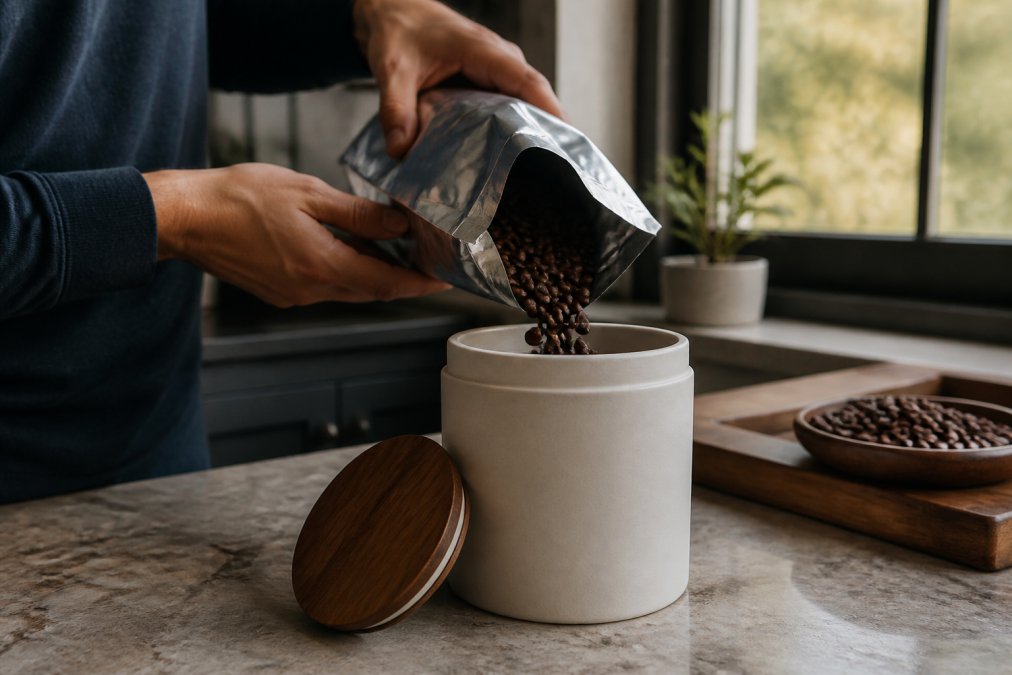
This routine takes less than a minute per day and makes a measurable difference in the cup. The beans stay at their peak for the full two to four week window, which means every brew tastes like the origin it came from, whether that is a bright Ethiopian natural or a deep, chocolatey Colombian.
Common Mistakes That Ruin Fresh Coffee
Several habits quietly destroy coffee freshness. The most common is storing beans in the refrigerator. The fridge is humid, full of food odors, and opened constantly, exposing beans to moisture and temperature swings. The result is coffee that absorbs the smell of last night's leftovers and goes stale faster. Keep beans out of the fridge, period.
Another frequent error is leaving beans in the original bag after opening. Many specialty bags have a one-way valve that is great for shipping, but once opened, the bag does not reseal tightly enough to keep oxygen out. Transfer the beans to a proper container. Grinding too much at once is a third mistake, as ground coffee loses its volatile compounds within hours. Grind only what you need for the current brew.
A final mistake is buying coffee without checking the roast date. Grocery store shelves are full of bags roasted months ago, and no storage method can revive beans that are already stale. Look for a roast date within the last two weeks, and buy from roasters who prioritize freshness and ethical sourcing, like the farms we partner with at Far Destinations Coffee, where every batch is crafted to deliver a smooth, rich experience. Sustainable storage also means buying what you will actually drink, which reduces waste and ensures every cup is at its best.
The Humidity Factor Most Guides Ignore
Most storage advice assumes a temperate, moderate-humidity environment. But the United States spans dramatically different climate zones, and your local humidity directly affects how long coffee stays fresh. In humid regions like the Southeast, the Gulf Coast, or the Pacific Northwest during winter, ambient relative humidity regularly exceeds 70 percent (noaa.gov). In arid climates like the Southwest or the Mountain West, humidity often drops below 20 percent.
High humidity is the stealth killer of coffee freshness. Roasted coffee beans are hygroscopic, meaning they actively absorb moisture from the air. When beans absorb water, the cell structure swells and softens, accelerating the breakdown of aromatic oils. Moisture also enables hydrolysis reactions that convert flavor precursors into dull, papery compounds, and it creates conditions for mold growth, especially if beans are stored for more than a month. In a humid climate, a container that is merely "mostly sealed" is not enough. You need a true airtight seal with a silicone gasket, and you should avoid opening the container more than necessary.
Low humidity presents a different problem. In arid environments, beans can dry out excessively, losing the moisture that helps carry volatile aroma compounds to your nose. Overly dry beans produce a cup that tastes flat and hollow, even if the beans are otherwise fresh. If you live in a dry climate, consider a container with a slightly less aggressive seal, or add a small piece of food-grade humidity pack designed for coffee to maintain an optimal internal environment.
Altitude Changes Storage Math
Altitude affects atmospheric pressure, which in turn affects how quickly coffee degasses and stales. At higher elevations, such as Denver or Salt Lake City, lower atmospheric pressure means carbon dioxide escapes from roasted beans more rapidly. This is not inherently bad, but it means the degassing phase finishes sooner, and the beans transition into the oxidation phase faster. In practical terms, coffee stored at altitude loses its peak flavor window more quickly than the same coffee stored at sea level.
If you live above 5,000 feet, adjust your expectations (PubMed). The two-to-four-week peak flavor window for whole beans shrinks to roughly one-to-three weeks. Buy smaller bags more frequently, and prioritize containers with the tightest possible seal to slow oxygen ingress. Conversely, at sea level, higher atmospheric pressure slows degassing slightly, giving you a marginally longer freshness window.
Condensation: The Freezer's Hidden Trap
Condensation is a particular problem if you move beans between a cold environment and a warm room. When you pull a container out of the freezer, warm room air hits the cold surface and condenses into water droplets. If the container is not completely airtight, that moisture finds its way onto the beans. Even a few drops of water on frozen beans can cause localized staling and, over repeated freeze-thaw cycles, freezer burn. The solution is to portion beans into single-use vacuum-sealed bags before freezing, and to let the sealed bag come to room temperature for 30 minutes before opening it, so condensation forms on the outside of the bag rather than on the beans.
The Wet Spoon and Other Small Offenses
Never scoop beans with a wet spoon. Even a few drops of water introduced into a canister raises the local humidity inside the container and can cause clumping and premature staling. Use a dry, clean scoop every time. Similarly, do not return beans to the container after they have been exposed to steam from a brewing setup. Keep the container closed while you heat water, and open it only long enough to scoop the beans you need.
Conclusion: Small Changes, Better Cups
Storing coffee properly is not about expensive equipment or complicated rituals. It comes down to controlling the four enemies, oxygen, light, heat, and humidity, with an airtight, opaque container kept in a cool, dark place. Buy whole beans with a recent roast date, grind right before brewing, and skip the freezer unless you are storing for the long term.
The reward is a cup that tastes like the farm, the roast, and the care that went into it. At Far Destinations Coffee, we source our beans from trusted farms around the world and roast them to bring out their natural character, but we can only control the beans until they leave our roastery. The final step is yours, and it takes less than a minute a day.
Frequently Asked Questions
Will coffee stay fresh in a Ziploc bag?
A Ziploc bag is better than leaving beans in an open bag, but it is not a good long-term solution for storing coffee to keep freshness. The plastic is not an airtight container and allows oxygen to pass through over time. Squeeze out as much air as possible before sealing and keep the bag in a cool, dark place. For best results, transfer your beans to a proper airtight container with a one-way valve within a few days.
Should you store coffee beans in the freezer?
Freezing coffee beans can help preserve freshness, but only if done correctly. Never freeze beans in their original bag. Instead, divide the beans into small, airtight, freezer-safe portions. Remove only what you need for a few days and let it come to room temperature before opening to avoid condensation. Freezing is most useful for storing large quantities, like a 5lb bag, that you will not finish within a few weeks. Frequent temperature changes will degrade quality.
Is 2-year-old coffee still good?
Coffee that is two years old will not be dangerous to drink, but it will have lost almost all of its aroma and flavor. Coffee is at its peak flavor within a few weeks of its roast date. After that, oxidation and moisture degrade the volatile compounds that give coffee its character. Stale coffee often tastes flat, cardboard-like, or overly bitter. You can still brew it, but you will not experience the flavor profile the roaster intended. Check the roast date, not the best-by date, to gauge how long does coffee stay fresh.
Does light or heat affect coffee bean freshness?
Yes, both light and heat accelerate the degradation of coffee beans. UV light and heat exposure speed up oxidation, causing the oils in the beans to break down more quickly. This leads to a loss of aroma and a rancid or flat taste. Store your coffee in a cool, dark place like a pantry cabinet, away from the stove, oven, or a sunny windowsill. An opaque, airtight container is your best defense against these elements.