

How to Tell if Coffee Beans Are Fresh
Table of Contents
- Why Roast Date Matters More Than Expiration Date
- The Visual and Aroma Test: Your First Indicators
- The Bloom Test: A Hands-On Method
- How to Store Coffee to Keep Freshness
- Recognizing Stale Coffee: Common Signs
- Light Roast vs. Dark Roast: Freshness Window Differences
- Practical Steps to Test Your Beans at Home
- Frequently Asked Questions
Last Updated: September 27, 2026
Why Roast Date Matters More Than Expiration Date
Understanding how to tell if coffee beans are fresh starts with the roast date, your most reliable indicator of freshness. Many coffee buyers mistakenly focus on expiration dates, but the roast date tells you exactly when the beans were processed and when their flavor window begins to close.
Coffee beans lose peak flavor immediately after roasting. The roast date gives a concrete reference point; an expiration date only indicates safety, not optimal flavor.
A bag roasted three weeks ago tastes noticeably different from one roasted three days ago, even if both are technically fresh.
Look for bags showing the specific roast date. If you see only an expiration date with no roast date, that's a red flag.
The Visual and Aroma Test: Your First Indicators
Structured Visual Inspection Checklist
Visual assessment requires a systematic approach. Use a repeatable checklist instead of gut feeling.
Lighting matters. Evaluate beans in natural daylight or bright white light. Pour beans into a white bowl to maximize contrast.
Color consistency. Fresh beans show uniform color. Uneven color or grayish/ashy tint indicates oxidation and staleness.
Surface appearance and oils. Light and medium roasts show subtle sheen; dark roasts show glossy oils. Excessive oiliness or sticky feel indicates age. Matte, chalky appearance suggests oil degradation.
Surface defects. A visible layer of fine powder or extensive cracking indicates age and staleness.
Density and size. Fresh beans appear plump and uniform. Noticeably smaller or shriveled beans indicate significant age.
Structured Aroma Evaluation Protocol
The initial sniff test. Open the bag and take a strong sniff. Is the aroma inviting and complex, or weak and flat? Fresh beans announce themselves with alive, dynamic smell.
Identifying aroma notes. Fresh beans release multiple distinct aromas (fruity, floral, chocolate, nuts, caramel, spice). Stale beans smell one-dimensional.
The time-decay test. Sniff immediately, then again after 30 seconds. Fresh beans maintain strong aroma; stale beans fade quickly.
Detecting off-flavors in aroma. Musty, cardboard-like, or rancid smells indicate oxidation and staleness.
Comparing to a reference. Smell fresh beans side-by-side with the beans you're evaluating. The contrast reveals freshness clearly.
What Fresh Beans Look Like
Fresh coffee beans have a distinct appearance. They should look vibrant and uniform in color, with a slight sheen from natural coffee oils. The surface may appear slightly oily or glossy, which is normal and actually a good sign.
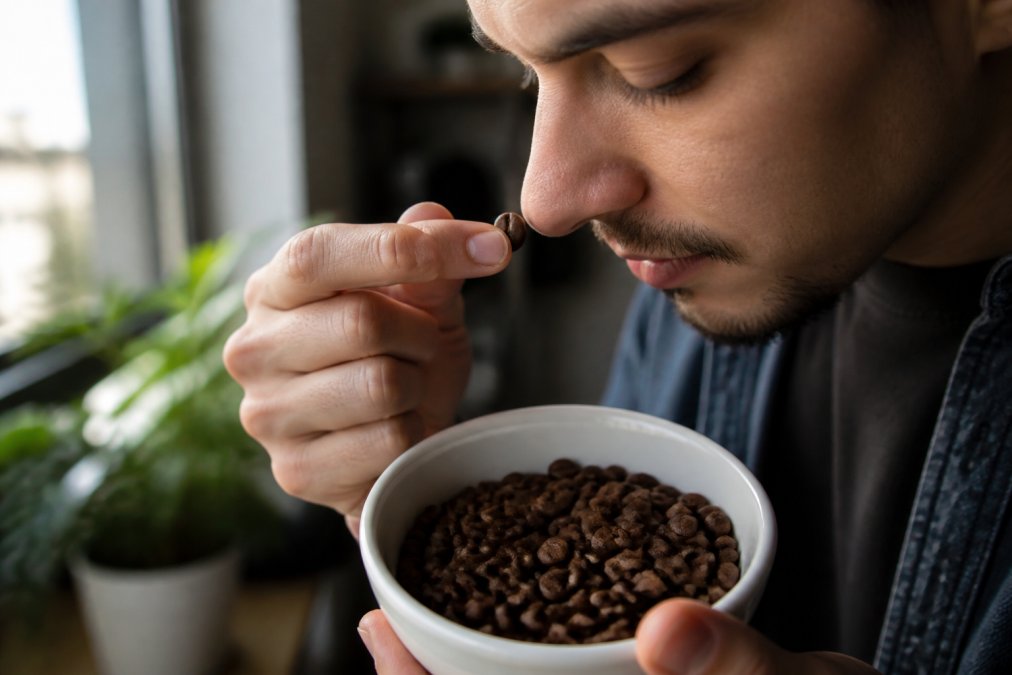
Stale beans look dull and chalky. The color becomes muted. You might notice a flat, lifeless appearance compared to fresh beans sitting beside them. If the beans look visibly dusty or have a gray coating, they've been exposed to air for too long.
The bean's surface tells a story. Darker roasts naturally have more visible oils. Light roasts appear drier. But within each roast level, fresh beans maintain a consistent, rich appearance.
Assessing Aroma and Flavor Profile
The aroma test is immediate and reliable. Open a bag of fresh beans and take a strong sniff. You should detect a complex, inviting smell, not flat or stale.
Fresh beans release a vibrant aroma. The scent should feel alive and dynamic. You might pick up notes specific to the bean's origin: fruity, floral, chocolatey, or nutty depending on where the beans came from and how they were roasted.
Stale beans smell muted. The aroma becomes thin and one-dimensional. Sometimes stale coffee smells slightly musty or cardboard-like. If you open a bag and the smell is underwhelming, the beans have likely lost significant flavor compounds.
The flavor profile changes as beans age. Fresh beans deliver complexity. You taste multiple layers. Stale beans taste flat and one-note. The acidity and body both diminish. What should be a smooth, rich cup becomes thin and uninspiring.
Single Origin Favorites Sample Pack →
The Bloom Test: A Hands-On Method
The bloom test requires only hot water. Grind beans coarsely, pour hot water over them, and observe for 30 seconds. Fresh beans bloom dramatically with visible swelling and bubbles. Stale beans bloom weakly or not at all. A strong bloom lasting 20-30 seconds indicates freshness; weak bloom indicates aging.
How to Store Coffee to Keep Freshness
Understanding Packaging Technology: One-Way Valves and Nitrogen Flushing
Professional coffee packaging uses two critical technologies: one-way valves and nitrogen flushing.
One-way valves allow CO₂ to escape while preventing oxygen from entering. Oxygen causes coffee to go stale. Look for bags with visible valve ports on the side or bottom.
Nitrogen flushing replaces oxygen-rich air with inert nitrogen, dramatically slowing staling. Bags flushed with nitrogen maintain freshness significantly longer than bags filled with regular air.
Whole Bean vs. Pre-Ground: Which Stays Fresher
Whole beans maintain peak flavor for 2-4 weeks after roasting; pre-ground coffee declines within days. Buy whole beans and grind just before brewing for best results.
Container and Environment Factors
Store whole beans in an airtight container away from light, heat, and moisture. Use opaque containers or dark cupboards. Keep room temperature consistent (65-75°F). Avoid humid environments. Keep containers sealed tightly.
The refrigerator and freezer are debated among coffee enthusiasts. Cold slows oxidation, which sounds beneficial. But temperature fluctuations when you open and close the door introduce condensation. This moisture damages beans and can cause flavor absorption from other foods. If you must refrigerate, store beans in a sealed, airtight container (not the original bag) and allow them to come to room temperature before opening to minimize condensation. Most experts recommend avoiding refrigeration for beans you'll use within 4 weeks. For long-term storage (months), freezing in an airtight, vacuum-sealed container can work, but it's rarely necessary for home use.
Recognizing Stale Coffee: Common Signs
Stale coffee displays several unmistakable characteristics. Learn to recognize them and you'll avoid disappointing cups.
Flat taste is the most common sign. The coffee lacks complexity. Flavors feel one-dimensional. What should be a multi-layered experience becomes boring.
Muted aroma indicates age. Open the bag and the smell feels weak or absent. Fresh coffee demands attention with its scent. Stale coffee barely registers.
Lack of bloom when you brew suggests advanced age. The grounds don't swell or bubble noticeably. This signals that degassing has essentially completed.
Dull appearance is visual confirmation. The beans look chalky or gray instead of vibrant. The natural oils appear diminished.
Thin body in your cup is noticeable. The coffee feels watery or insubstantial. Fresh coffee has weight and texture. Stale coffee feels hollow.
Reduced acidity changes the overall profile. Acidity in coffee isn't necessarily sour, it's brightness and complexity. Stale beans lose this quality, making the cup feel flat.
Musty or cardboard notes sometimes appear in very stale coffee. These off-flavors indicate oxidation has progressed significantly.
If you notice any combination of these signs, the beans have moved past their optimal flavor window.
Light Roast vs. Dark Roast: Freshness Window Differences
Light roasts and dark roasts have different freshness windows. Understanding these differences helps you time your purchases appropriately.
Practical Steps to Test Your Beans at Home
Learning how to tell if coffee beans are fresh doesn't require special equipment. These simple tests require only items you already have.
Frequently Asked Questions
How long do coffee beans stay fresh after roasting?
Most coffee beans are at peak freshness between 5 and 30 days after the roast date. During this window, the degassing process releases carbon dioxide, which enhances aroma and flavor extraction. After 30 days, the beans begin to lose their vibrant flavor profile and aroma. While whole beans remain drinkable for 2-3 months when stored properly, the sensory experience, acidity, body, and aftertaste, gradually diminishes. Pre-ground coffee loses freshness much faster, typically within 1-2 weeks.
Does the roast date matter more than the expiration date?
Yes, roast date is far more important. The roast date tells you exactly when the beans were roasted and began their freshness window. An expiration date is often arbitrary and doesn't reflect actual flavor quality. Beans roasted 2 weeks ago are fresher than beans with an expiration date 6 months away if they were roasted 4 months ago. Always prioritize the roast date when choosing beans, and look for bags labeled with the specific date rather than vague terms like 'fresh' or 'recently roasted.'
What is the bloom test for coffee?
The bloom test measures how much carbon dioxide escapes from fresh beans when hot water first contacts them. Grind a small amount of fresh beans and pour hot water over them; fresh beans will visibly bubble and release aroma within 5-10 seconds. Stale beans show little to no bloom. This happens because fresh beans still contain trapped gases from the roasting process, while oxidation in stale beans releases those compounds over time. It's a quick, reliable way to confirm freshness without brewing a full cup.
Can you tell if coffee beans are fresh by smell alone?
Aroma is a strong indicator but not foolproof on its own. Fresh beans have a vibrant, complex smell, fruity, floral, or chocolatey notes depending on origin and roast level. Stale beans smell flat, muted, or dull. However, some people's sense of smell varies, and certain varieties naturally have subtle aromas. Combine the smell test with visual inspection (checking for oils on the surface, which indicate freshness) and the bloom test for a complete assessment. If the aroma seems weak or the beans look dull, they're likely past their prime.