

Buy Ethically Sourced Coffee Beans: 2026 Guide
Table of Contents
- Why Buy Ethically Sourced Coffee Beans in 2026
- How to Identify Ethical Coffee Labels
- Fair Trade Coffee Brands: What Certifications Actually Verify
- The Benefits of Direct Trade Coffee for Farmers and Flavor
- Single-Origin Coffee Comparison: Tasting Notes, Roast, and Price
- How Far Destinations Coffee Sources and Roasts Its Beans
- Budget-Friendly Ethical Coffee: How to Buy Ethically Sourced Coffee Beans Without Overspending
- Conclusion
- Frequently Asked Questions
Last Updated: September 16, 2026
Why Buy Ethically Sourced Coffee Beans in 2026
When you buy ethically sourced coffee beans, you're paying for more than a morning ritual. You're funding a supply chain where the farmer who grew your coffee earns a living wage, works land that stays healthy for the next harvest, and gets recognized for quality rather than volume. At Far Destinations Coffee, we've built our entire sourcing model around that principle: beans from trusted farms, roasted to bring out their natural flavor, aroma, and character.
Here's the part most guides skip. Ethical sourcing isn't a single stamp on a bag. It's a set of overlapping practices, from how cherries are picked to how they're dried, milled, shipped, and roasted. Understanding those layers is what separates a genuinely ethical purchase from a marketing claim.
Below, we'll break down how to read labels, what certifications actually verify, why direct trade relationships change both farmer livelihoods and cup quality, and how to do all of it without overspending. The U.S. Department of Agriculture's organic standards overview is a useful starting point for understanding what "certified organic" legally means on a coffee bag.
How to Identify Ethical Coffee Labels
Learning how to identify ethical coffee labels starts with one distinction: is the claim third-party verified, or self-declared? A roaster can print "sustainably grown" or "farm-direct" on any bag without proving a thing. A certification logo means an outside auditor checked the operation against a published standard, and, in most cases, re-checks it on a recurring cycle.
The labels that carry real weight, and what each one actually verifies:
- Fair Trade certified (Fairtrade America / Fair Trade USA): Verifies a minimum price floor paid to growers plus a social premium paid to cooperatives, and that buying happens through a democratically organized co-op. It does not verify pesticide use, shade cover, or cup quality.
- USDA Organic: Verifies farming meets federal organic standards, restrictions on synthetic pesticides and fertilizers, buffer zones against conventional fields, and a documented audit trail from farm to roaster. It says nothing about farmer pay or biodiversity.
- Rainforest Alliance: Verifies a combined environmental and social standard, biodiversity protection, soil and water management, shade requirements, and worker protections. It is broader than Organic but does not guarantee a price floor the way Fair Trade does.
- Bird Friendly (Smithsonian Migratory Bird Center): The strictest shade standard. Requires shade-grown, organic conditions with a documented canopy structure that supports migratory bird habitat. It is also the rarest, far fewer farms hold it.
- B Corp: Verifies the company, not the coffee. A B Corp certification means the roaster met social and environmental performance benchmarks across its whole operation. It does not certify how any single farm was run.
What most shoppers miss is that these certifications measure different things, so they are not interchangeable and they are not additive in a simple way. Organic says nothing about farmer pay. Fair Trade says nothing about pesticide use. Bird Friendly implies organic conditions but is not a substitute for a price guarantee. Reading two or three logos together gives you a fuller picture than any single one, but the logos still leave gaps that only a named farm relationship can close.
A practical way to read a bag: separate the claims into three buckets, environmental (Organic, Rainforest Alliance, Bird Friendly), economic (Fair Trade, direct trade), and company-level (B Corp). A bag that covers at least one from the environmental bucket and one from the economic bucket is doing more than most.
Fair Trade Coffee Brands: What Certifications Actually Verify
Fair trade coffee brands operate under a model that guarantees a floor price for growers plus a social premium paid to cooperatives. That premium funds community projects chosen by the farmers themselves, from schools to processing equipment.
The Benefits of Direct Trade Coffee for Farmers and Flavor
Traceability matters here too. When you can name the region, the altitude, and the processing method, you're buying transparency, not a story.
Single-Origin Coffee Comparison: Tasting Notes, Roast, and Price
Single-origin coffee comes from one defined region rather than a blend of multiple countries. That definition matters because it lets you taste what a specific place, altitude, and processing method actually contribute.
Here's how our current single-origin lineup compares:
| Coffee | Roast Level | Tasting Notes | Region | Price |
|---|---|---|---|---|
| Ethiopia Natural | Medium-light | Milk chocolate, fruity, caramel | Sidama Zone | $22.99 |
| Kenya | Medium | Orange, lemon, floral | Nyeri County | $22.99 |
| Colombia | Medium | Dried orange, berry, chocolate | Antioquia | $22.99 |
| Costa Rica | Medium | Sweet apple, raisin, honey | Alajuela | $22.99 |
| Peru | Medium | Salted caramel, citrus | Piura, Amazonas | $22.99 |
| Uganda | Medium | Floral, chocolate, dark fruits | Kapchorwa District | $22.99 |
| Sumatra | Medium | Dark chocolate, dried fruit, earthy | Aceh, Takengon | $22.99 |
| Sample Pack (6 x 2 oz) | Varies | Six origins to compare | Multiple | $24.99 |
How Far Destinations Coffee Sources and Roasts Its Beans
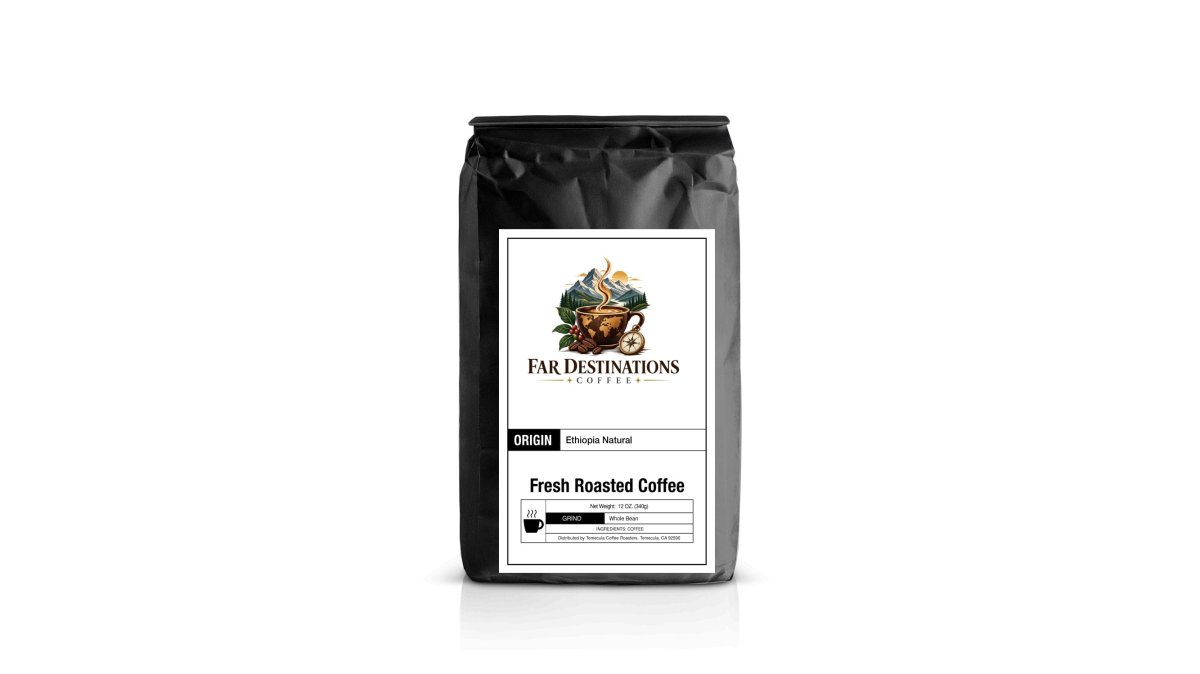
Every coffee we sell traces back to a named farm, cooperative, or growing region. Our Ethiopia Natural comes from smallholder farmers in the Sidama zone growing indigenous heirloom cultivars at 1,700 to 1,900 meters, fully natural processed and dried on raised beds. Our Colombia lots come from smallholder farmers around Medellín, washed and dried in solar dryers to protect the crop from rain.
Single Origin Favorites Sample Pack →

Budget-Friendly Ethical Coffee: How to Buy Ethically Sourced Coffee Beans Without Overspending
Buying ethically sourced coffee beans on a budget comes down to three moves: buy whole bean, buy in the right quantity, and use a sample pack to find your match before committing to full bags. But there's a fourth consideration most budget guides skip entirely, the carbon footprint of getting the coffee to your door, which is where a lot of the environmental story actually lives.
Three questions worth asking a roaster:
-
Start with a sample pack. Our Single Origin Favorites Sample Pack is $24.99 for six 2-ounce bags, letting you taste Brazil, Colombia, Costa Rica, Ethiopia, Honduras, and Tanzania before buying a full size.

Colombia -
Match the roast to your brew method.
-
Buy only what you'll drink in three to four weeks. Freshness beats bulk pricing every time, and smaller, more frequent orders mean less coffee going stale in the cupboard.
-
Grind at home if you can. Pre-ground coffee stales faster, which pushes you to buy more often, the opposite of a budget win.
Conclusion
The gap between an ethical claim and an ethical purchase comes down to verification, and that takes a little effort on your end. Far Destinations Coffee makes that easier by naming every farm, region, altitude, and process behind each bag, then roasting in small batches so the quality matches the sourcing story. Start with the Single Origin Favorites Sample Pack at $24.99, find the origin that fits your morning ritual, then move to full bags of Ethiopia Natural, Kenya, Colombia, or any of our other single origins at $22.99 each.
Frequently Asked Questions
What coffee brands are ethically sourced?
Ethically sourced coffee brands typically carry third-party certifications such as Fair Trade, USDA Organic, or Rainforest Alliance, or they publish direct trade relationships with named farms and cooperatives. Look for roasters that disclose the grower, region, altitude, and processing method on the bag. Far Destinations Coffee, for example, lists the specific cooperative or farm for each single origin, like the Cooperativa Agricola de Servicisios Norandino in Peru or the KBQB coop in Sumatra, so you can trace exactly where your beans came from.
How can I tell if my coffee beans are ethically sourced?
Check the bag for a certification seal, a named farm or cooperative, and details like altitude and processing method. Certifications such as Fair Trade, USDA Organic, and Rainforest Alliance require third-party verification of environmental and labor standards. If a roaster lists the grower, region, and processing method, that is a strong sign of supply chain transparency. You can also visit the roaster's website to see if they publish sourcing reports or direct trade relationships with small-scale farmers.
What do Fair Trade and Organic certifications mean for coffee?
Fair Trade certification sets minimum prices and social premiums for farmers, aiming to support a living wage and community projects. USDA Organic certification verifies that beans are grown without synthetic pesticides or fertilizers, supporting soil health and biodiversity. Both require third-party verification, so they offer a reliable baseline. However, certifications alone do not guarantee top flavor quality. Many specialty roasters go beyond certification by building direct trade relationships and paying premium pricing based on cup quality.
Is it more expensive to buy ethically sourced coffee beans?
Ethically sourced coffee often costs more than commodity grocery store coffee because it includes a living wage for farmers, sustainable agriculture practices, and supply chain transparency. However, you can find budget-friendly options. For example, Far Destinations Coffee sells single-origin bags for $22.99 and a six-pack Single Origin Favorites Sample Pack for $24.99, which lets you try six different origins before committing to a full bag. Buying whole beans and brewing at home also lowers your cost per cup compared to cafe drinks.
What is the 15-15-15 coffee rule?
The 15-15-15 coffee rule is a brewing guideline that suggests using a 15:1 water-to-coffee ratio, brewing for 15 minutes, and drinking within 15 minutes for optimal flavor. While not a sourcing standard, it can help you get the most out of your ethically sourced beans. For most home brewers, a 15:1 ratio by weight is a good starting point, and adjusting grind size and water temperature will have a bigger impact on taste than strict timing.