

Freshly Roasted Coffee Beans for Sale: 2026 Guide
Table of Contents
- What Makes Freshly Roasted Coffee Beans Worth Buying
- Coffee Beans Roasted to Order: Why Timing Matters
- Best Whole Bean Coffee Options: Single-Origin vs. Blends
- How to Store Coffee Beans for Maximum Freshness
- How Long Do Coffee Beans Stay Fresh After Roasting
- Roast Profiles and Flavor: Light, Medium, and Dark Explained
- Brewing Method Recommendations for Your Beans
- What to Look For When Buying Freshly Roasted Coffee Beans
- Frequently Asked Questions
Last Updated: October 9, 2026
What Makes Freshly Roasted Coffee Beans Worth Buying
Freshly roasted coffee beans deliver volatile aromatics, brighter acidity, and origin characteristics that grocery store bags sitting on shelves for weeks can't offer.
At Far Destinations Coffee, our entire operation is built on this principle: freshness defines quality.

Most drinkers have adapted to the muted, flat profile of coffee oxidizing in bags for months. Once you taste freshly roasted coffee beans roasted just days before brewing, going back feels impossible.
Coffee Beans Roasted to Order: Why Timing Matters
Most roasters hold inventory, so your beans might be a week old before they ship, already past their peak window on arrival.
Roasting to order means the roaster doesn't start until you order. It adds a few days to delivery.
Coffee releases CO2 and volatile compounds for 7-14 days after roasting, a process called degassing. Beans too fresh (1-2 days) taste sour; beans too old (4+ weeks) have lost their aromatics. The sweet spot is 5-14 days post-roast.
Ordering freshly roasted coffee beans lets you time your purchase to land in that optimal window, you control when peak flavor arrives.
Best Whole Bean Coffee Options: Single-Origin vs. Blends
Understanding the tradeoff between single-origin and blended coffee helps you match your palate and brewing method.
Single-Origin Coffees
Single-origin beans come from one farm, region, or country, the purest expression of terroir, where soil, altitude, climate, and processing create a unique flavor profile. An Ethiopian tastes completely different from a Brazilian, even at the same roast level.
Single-origins shine when you want to taste a place: Ethiopian naturals show fruity, floral notes, Brazilians tend toward chocolate and smoothness, and Kenyans display berry and wine-like characteristics.
The tradeoff is consistency: single-origins are more delicate and vary between harvests. If you're used to a balanced house blend, a single-origin might taste bright or acidic at first, that's the point.
Far Destinations Coffee's Single Origin Favorites Sample Pack includes six distinct single-origins at $24.99: Brazil Santos with cocoa notes, Colombia with dried orange and berry, Costa Rica with sweet apple and honey, Ethiopia with milk chocolate and fruit, Honduras with caramel and spice, and Tanzania with pear and floral notes. Starting with a sampler lets you find which origins resonate with your palate before committing to full bags.
House Blends and Specialty Blends
Blends combine beans from multiple origins for a consistent, balanced profile. A good blend is intentional, perhaps a Brazilian base for body with African beans for brightness. The result is forgiving and consistent from bag to bag.
Blends work especially well with a basic drip machine or French press, and they're the right choice for reliability, the roaster has engineered consistency into the recipe.
Far Destinations Coffee's Best Sellers Sample Pack ($24.99) includes blended options: the 6Bean Blend as a dark roast for espresso, the Cowboy Blend combining dark and medium roasts with cocoa and caramel, and the Breakfast Blend as a smooth medium roast from South America.

Neither option is objectively better, it's about what you want. Single-origin for exploration and complexity; blends for consistency and approachability.
| Coffee Type | Flavor Profile | Best For | Consistency |
|---|---|---|---|
| Single-Origin | Bright, complex, origin-specific | Exploring different regions | Varies by crop |
| House Blend | Balanced, smooth, consistent | Daily brewing, all methods | Highly consistent |
| Specialty Blend | Intentional flavor combination | Specific brewing methods | Consistent recipe |
How to Store Coffee Beans for Maximum Freshness
Storage is where most coffee drinkers lose their investment. Even the best freshly roasted coffee beans degrade faster than time alone if stored poorly.
Coffee's enemies are air, light, heat, and moisture: oxygen breaks down aromatics, light accelerates degradation, heat speeds aging, and moisture introduces mold and off-flavors.
The best storage is airtight, opaque, and cool: a sealed glass or ceramic container in a pantry away from the stove or windows. Avoid the freezer unless storing for months, freezing and thawing creates condensation.
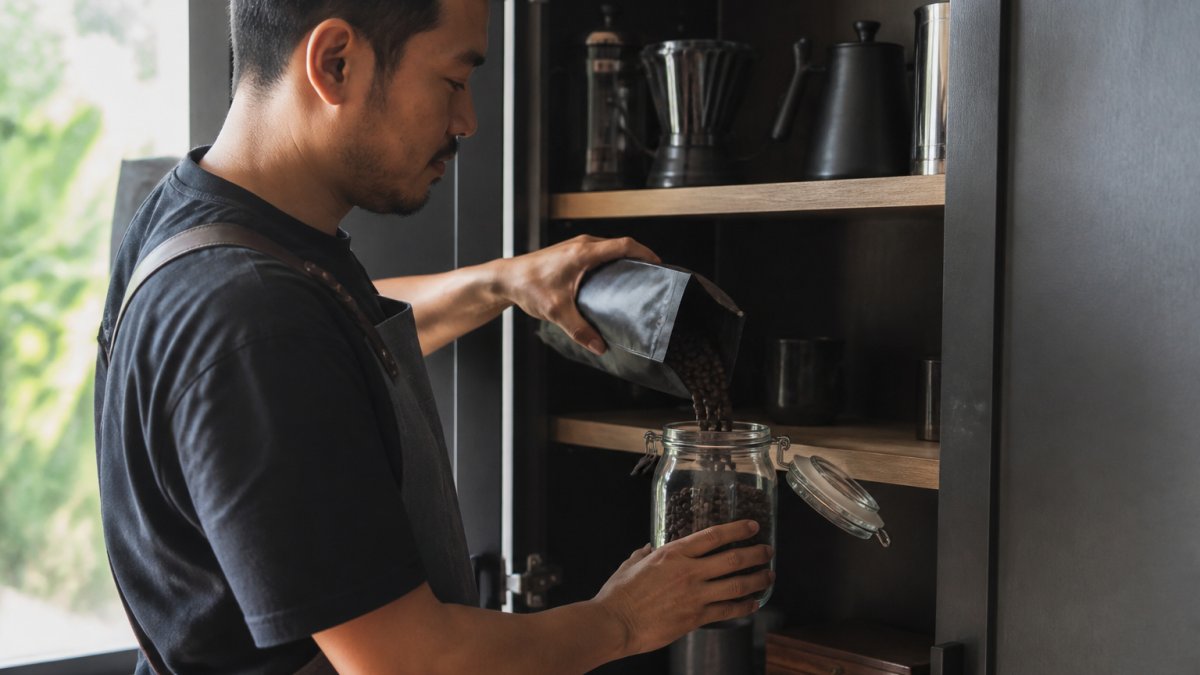
Many coffee bags have one-way valves that let CO2 escape while blocking oxygen, so you can store beans in the bag and seal it tightly.
Don't store coffee in the refrigerator: temperature fluctuations introduce condensation, and the fridge absorbs coffee aromatics. Room temperature in a dark cabinet is ideal.
Whole beans stay fresh longer than ground coffee because grinding dramatically increases surface area, accelerating oxidation. If you grind your own beans, which we recommend, grind just before brewing. Pre-ground coffee loses its peak flavor within hours.
How Long Do Coffee Beans Stay Fresh After Roasting
The freshness window for coffee is shorter than most people realize. Peak flavor occurs 5-14 days after roasting, when degassing has stabilized and oxidation hasn't yet damaged aromatics.
Beans stay drinkable for 3-4 weeks after roasting, but acidity softens, brightness fades, and the coffee tastes flatter. By 8 weeks it's stale by specialty standards, consumable, but a ghost of what it was.
The roast date is the most important number on your bag, look for it before you buy. If a bag doesn't list one, that's a red flag; you can't know if the beans are 2 weeks or 3 months old. At Far Destinations Coffee, we print the roast date on every bag.
Storage conditions affect how quickly beans fade. Airtight, cool, dark storage extends the acceptable window by a week or more.
Single Origin Favorites Sample Pack →
The practical timeline: order freshly roasted coffee beans about 7-10 days before you plan to brew, then consume within 3-4 weeks. After that they're not bad, but no longer what the roaster intended.
Roast Profiles and Flavor: Light, Medium, and Dark Explained
Roast level is one of the most misunderstood aspects of coffee. Many assume darker roasts are "stronger," but roast level affects flavor profile, not caffeine, which is virtually identical across levels.
Light roasts preserve more origin characteristics, roasted to "first crack" where the bean's cellular structure begins to rupture. They retain more acidity, complexity, and specific flavor notes, a light roast Ethiopian natural gives the full expression of the bean. They work best with pour-over, drip, or French press.
Medium roasts balance origin characteristics with roasted flavors, past first crack but not as far as a dark roast, the sweet spot for most drinkers. They work with any brewing method. Far Destinations Coffee's single-origins, Peru, Colombia, Brazil Santos, are all medium roasts.
Dark roasts push past second crack, where the bean's oils surface, emphasizing roasted flavors: chocolate, caramel, sometimes smoky notes. Origin characteristics become secondary. Bold and forgiving, they're the traditional espresso choice because the heavier body cuts through milk. The 6Bean Blend works exceptionally well for espresso drinks.
Your brewing method should influence your roast choice. Espresso pulls shots quickly, so darker, fuller-bodied roasts perform better. Pour-over and drip have longer water contact time, highlighting lighter roasts' complexity. French press creates a heavier cup, so medium to dark roasts shine.
Brewing Method Recommendations for Your Beans
Your brewing method dramatically affects how freshly roasted coffee beans taste, the same beans can taste bright in a pour-over or flat in a low-quality drip machine.
Pour-over methods (Chemex, V60, Kalita Wave) give precise control over water temperature, pour rate, and contact time, highlighting delicate flavors. They're ideal for single-origin coffees, and medium and light roasts perform best.
French press creates a heavier, full-bodied cup because grounds stay in contact with water for 4 minutes. Medium to dark roasts stand up to immersion brewing; lighter roasts can taste thin.
Automatic drip machines are the most forgiving, working with any roast level. The tradeoff is precision, less control over water temperature and brew time. Medium roasts are the safest choice.
Espresso machines require dark or medium-dark roasts. The quick 25-30 second extraction pulls oils and body from the bean; lighter roasts can taste sour or thin. Darker roasts provide the body and oils that create crema.
Moka pots and AeroPresses occupy a middle ground. Moka pots use espresso-like pressure, so medium-dark roasts work best.
The key principle: match your beans to your equipment. Basic drip machine? Buy medium roasts engineered for consistency. Quality pour-over setup? Buy lighter roasts that reward precision. Pulling espresso? Buy darker roasts designed for that method.
What to Look For When Buying Freshly Roasted Coffee Beans
Several factors separate genuinely fresh, high-quality coffee from average options. Knowing what to evaluate helps you match your preferences and budget.
The roast date is non-negotiable. Verify it's printed on the bag before you buy. If a seller won't tell you when the beans were roasted, find a different seller.
Look for transparency about origin: farm or cooperative, altitude, processing method. Far Destinations Coffee lists specific growers and regions because it signals intentional sourcing.
Roast level should be clearly labeled: light, medium, or dark. Skip roasters who use creative names that obscure the actual level, you need to know the roast so you can match it to your brewing method.
Check bag size and price. Most specialty roasters sell 12-ounce bags; Far Destinations Coffee's single-origins are $22.99 per 12-ounce bag.
Look for certifications if they matter to you. USDA Organic, Fair Trade, Direct Trade, and Cup of Excellence signal sourcing practices and quality standards.
Read reviews, but remember taste is personal. A bright, fruity coffee may not appeal if you prefer smooth and chocolatey. Use reviews to understand flavor characteristics, not to judge whether a coffee is "good."
At Far Destinations Coffee, we've built our entire operation on this principle. Our Single Origin Favorites Sample Pack and Best Sellers Sample Pack let you explore origins and roast levels without overcommitting.
Frequently Asked Questions
How can I tell if freshly roasted coffee beans are actually fresh?
Check the roast date on the package, it should be within 2-4 weeks of purchase. Freshly roasted beans will show visible oils on the surface and produce a strong aroma when opened. When brewed, fresh coffee has vibrant flavor and rich crema (for espresso). Beans that smell flat or taste dull have lost their peak freshness. Roasters who display roast dates transparently stand behind their product quality.
Should I buy coffee beans roasted to order instead of pre-roasted inventory?
Pre-roasted beans that ship immediately after roasting still deliver excellent freshness, especially if roasted within the last week. The difference matters most for specialty, single-origin coffees where subtle flavor notes shine. For everyday blends, either approach works well. What matters most is that roast date is clearly marked and the beans arrive within their optimal freshness window.
Will switching to freshly roasted specialty beans actually improve my morning coffee if I use a basic drip machine?
Yes. A drip machine brews water through grounds, and freshly roasted beans deliver noticeably better flavor, aroma, and body compared to stale grocery store coffee, regardless of equipment. You'll taste the difference immediately, smoother, richer, more complex flavor. Specialty beans are formulated to shine across brewing methods, not just expensive equipment. Start with a medium roast blend for familiar, approachable flavor, then explore single-origins to discover how different beans taste with your setup.
How do I verify that coffee beans are ethically sourced and not just marketing?
Look for specific details: named growers or cooperatives, altitude and region information, and processing method. Third-party certifications like Fair Trade or USDA Organic add verification. Direct-trade roasters often share photos and stories from the farms they work with. Compare what's printed on the bag, vague language is a red flag. Roasters committed to ethics provide traceability you can actually verify.
What's the best way to order freshly roasted coffee beans to ensure they arrive fresh?
Check shipping speed, beans should arrive within 3-5 business days. Track your delivery and store beans in an airtight container as soon as they arrive. Sample packs let you try multiple origins and roasts without committing to large quantities, making them ideal for discovering your preferences.