

Can Drip Coffee Machines Make Specialty Coffee?
Table of Contents
- Can Drip Coffee Machines Make Specialty Coffee?
- What Makes Coffee Specialty Grade
- SCA Certified Home Coffee Makers and Their Role
- Water Temperature Stability and Extraction Consistency
- Best Coffee-to-Water Ratio for Drip Machines
- How to Improve Drip Coffee Taste with Technique
- Maintenance and Descaling for Specialty Performance
- Troubleshooting Extraction Issues
- Frequently Asked Questions
Last Updated: September 29, 2026
Can Drip Coffee Machines Make Specialty Coffee?
The question of whether can drip coffee machines make specialty coffee reveals a common misconception: specialty coffee requires expensive equipment. The truth is more nuanced. A standard drip coffee machine can absolutely produce specialty-grade coffee, but only if you understand what makes coffee "specialty" in the first place and how to manipulate the variables that matter most.
The gap between mediocre and exceptional drip coffee comes down to precision, not price. Water temperature, brew time, grind consistency, and the coffee-to-water ratio are the levers that separate a forgettable cup from one that actually showcases the beans' origin characteristics. This guide walks you through exactly how to make specialty coffee with a drip machine.
What Makes Coffee Specialty Grade
Specialty coffee isn't a roast level or a brand, it's a standard. The Specialty Coffee Association defines specialty-grade beans as those scoring 80 points or higher on a 100-point scale during cupping evaluation. These beans are traceable to their origin, grown at higher elevations, processed with care, and roasted to highlight their unique flavor profile rather than mask defects.
The key difference between specialty and commodity coffee is extraction consistency. Commodity coffee tolerates brewing mistakes because the beans themselves are often a blend of lower-grade lots. Specialty beans demand precision. They reward it with complexity: citrus notes, chocolate undertones, floral aromatics, and a clean finish that lingers.
Your drip machine can achieve this. What it requires is understanding how water temperature, brew time, and saturation work together to extract the right compounds from the grounds.
SCA Certified Home Coffee Makers and Their Role
The Specialty Coffee Association publishes certification standards for home brewers, but understanding what those standards actually measure is crucial to knowing whether a certified machine is right for specialty coffee.
The SCA Home Brewer Certification Program evaluates three core performance areas: water temperature stability, spray pattern consistency, and brew time. Here's what each means in practice.
Water Temperature Stability is measured by tracking the temperature of water exiting the showerhead throughout a complete brew cycle. A certified machine must maintain water temperature between 195°F and 205°F, with no more than a 5°F variance from the average temperature during the brewing phase. This tight tolerance is critical because even a 10°F swing can shift extraction yield by 2-3%, moving a cup from balanced to noticeably sour or bitter.
Spray Pattern Consistency evaluates how evenly water is distributed across the coffee grounds. The SCA uses a specialized testing apparatus that measures water flow from the showerhead at multiple points. A certified machine must saturate at least 90% of the filter bed within the first 10 seconds of brewing. Machines with poor showerhead design create dry spots where water channels through without proper contact, leading to uneven extraction.
Brew Time is the total time water spends in contact with grounds, measured from first water contact to the last drop entering the carafe. The SCA standard requires a brew time between 4 and 6 minutes for a full pot. This window is based on extraction science: water needs sufficient time to dissolve flavor compounds, but too much time causes over-extraction. Machines that brew too quickly (under 4 minutes) under-extract; machines that brew too slowly (over 6 minutes) over-extract, especially with finer grinds.
Not every certified machine is expensive. Many mid-range drip brewers hold SCA certification because they use precision heating elements and properly engineered showerheads. What you're paying for is consistency, not luxury. A certified machine removes three variables from the equation, letting you focus entirely on grind size, dose, and water quality.
If your machine is SCA certified, you already have the hardware foundation for specialty coffee. If it isn't, you can still produce excellent coffee, but you'll need to monitor and adjust technique more carefully, and you'll need to account for temperature fluctuations or uneven saturation by adjusting your grind size or brew approach. The certification is a shortcut to consistency, not a requirement for quality.
Water Temperature Stability and Extraction Consistency
Water temperature is non-negotiable. Too cool and you under-extract, leaving sour, thin coffee. Too hot and you over-extract, producing bitter, harsh flavors. The sweet spot is 195-205°F, the range where specialty coffee reaches its optimal extraction yield.
The problem with many budget drip machines is temperature fluctuation. The heating element cycles on and off, causing the water to cool as it sits in the reservoir, then overheat when the element kicks back on. This inconsistency ruins extraction.
SCA certified machines solve this with precision heating elements that maintain a tight temperature band. But even without certification, you can work around this limitation. Use water that's already hot before it enters the machine. Pre-heat your carafe. These small adjustments stabilize the overall brewing environment.
The relationship between temperature and brew time is direct: hotter water extracts faster, cooler water extracts slower. Understanding this lets you adjust one variable if the other is imperfect.
Best Coffee-to-Water Ratio for Drip Machines
The golden cup standard recommends a 1:16 coffee-to-water ratio by weight. That means 1 gram of coffee for every 16 grams of water. For a standard 12-cup drip machine (60 ounces), this works out to roughly 0.4 ounces of ground coffee, or about 11 grams.
Most home brewers use far too little coffee. They eyeball it, dump in a scoop, and wonder why their coffee tastes weak. Weighing your coffee and water removes guesswork.
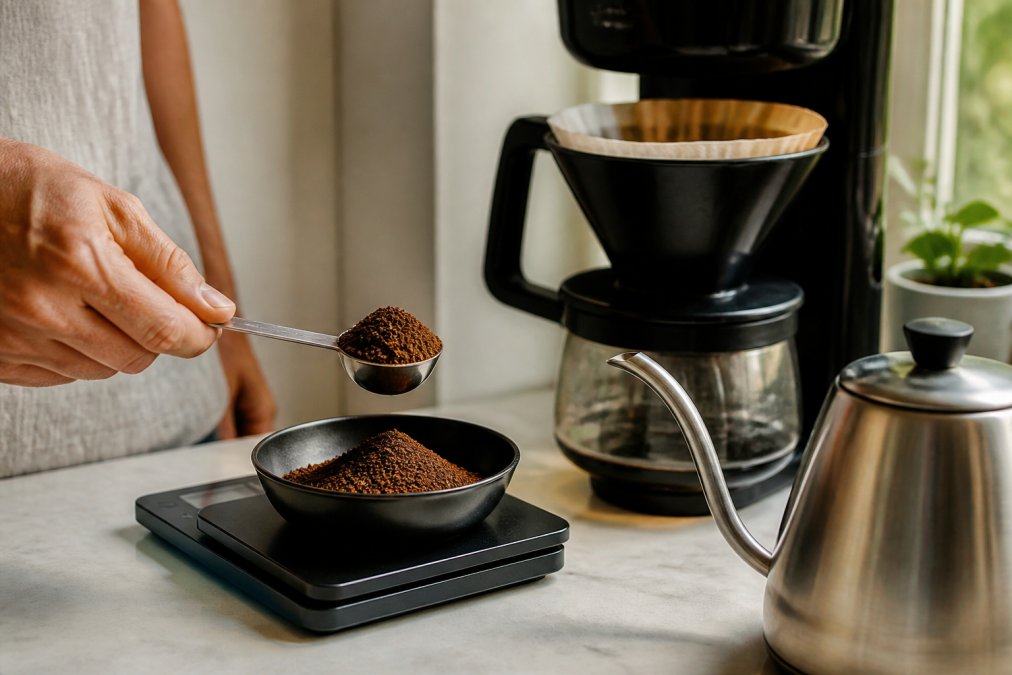
Start with the 1:16 ratio as your baseline. If the result tastes sour or thin, increase the coffee slightly (move toward 1:15). If it tastes bitter or heavy, reduce it (move toward 1:17). Your palate will guide you once you have a consistent starting point.
The ratio matters because it directly impacts total dissolved solids, the amount of flavor compounds extracted into your cup. Too little coffee means insufficient flavor. Too much means over-extraction and bitterness.
How to Improve Drip Coffee Taste with Technique
Technique transforms ordinary beans into exceptional coffee. Start with freshness: use beans roasted within the last two weeks. Older beans lose their volatile aromatics and produce flat, stale-tasting coffee. Far Destinations Coffee ships freshly roasted beans.
Grind size matters enormously. For drip machines, aim for a medium grind, slightly coarser than sand. Too fine and water passes too slowly, over-extracting. Too coarse and water rushes through, under-extracting. Consistency matters as much as size. A burr grinder (conical or flat) produces uniform particles. A blade grinder creates a mix of fines and chunks, leading to uneven extraction.
Bloom your grounds. Pour just enough hot water to saturate the coffee, then wait 30-45 seconds before pouring the rest. This allows CO2 to escape and water to penetrate the grounds evenly. Bloom cycles improve extraction yield noticeably.
Water quality affects flavor more than most brewers realize. Tap water with high mineral content or chlorine will influence taste. Filtered water, even a basic pitcher filter, removes chlorine and reduces mineral buildup that can affect your machine's performance.
Maintenance and Descaling for Specialty Performance
Mineral buildup inside your machine doesn't just reduce lifespan, it actively degrades the extraction consistency that specialty coffee demands. Understanding this connection is why maintenance matters more for specialty brewing than for commodity coffee.
When you brew, minerals dissolved in tap water (primarily calcium and magnesium) are left behind as water evaporates or passes through the grounds. Over time, these deposits accumulate on three critical components: the heating element, the showerhead, and the internal water lines.
On the heating element, mineral scale acts as an insulator. This forces the element to work harder to reach target temperature, causing temperature swings.
Troubleshooting Extraction Issues
If your drip coffee tastes sour, the problem is usually under-extraction. The water spent too little time in contact with the grounds. Solutions: use a finer grind, increase brew time by using cooler water, or increase your coffee dose. Start by grinding finer, it's the easiest adjustment.
Frequently Asked Questions
Can a basic drip coffee maker produce specialty-grade coffee?
Yes, a standard drip machine can brew specialty coffee if you control three variables: water temperature (195-205°F), grind size, and coffee-to-water ratio. Specialty coffee relies on extraction consistency and proper bloom cycles, both achievable in automatic drip machines. The difference between ordinary and specialty coffee comes down to bean quality, freshness, and brewing technique, not the equipment alone. Far Destinations Coffee's specialty-grade beans will reveal their full flavor profile in any drip machine when these fundamentals are met.
What water temperature should a drip machine maintain for specialty coffee?
Specialty coffee requires water temperatures between 195-205°F for optimal extraction. This range dissolves the right compounds from the grounds without over-extracting bitter notes. Many standard drip machines struggle with temperature stability, cooling water as it saturates the grounds. Look for machines with precision heating elements that maintain consistent temperature throughout the brew cycle. If your machine runs cooler, you may need to preheat the carafe or use hotter water from the tap to compensate.
What is the best coffee-to-water ratio for drip machines?
The golden ratio for drip machines is 1:16 (one part coffee to 16 parts water by weight). This translates to roughly 0.6 ounces (17 grams) of ground coffee per 10 fluid ounces of water. Start with this baseline and adjust to your taste preference, some prefer 1:15 for stronger flavor, others 1:17 for lighter body. Use a kitchen scale for accuracy; eyeballing leads to inconsistent extraction. This ratio works across all grind sizes and bean origins, making it the standard for achieving the golden cup standard that specialty coffee demands.
How often should I descale my drip machine for specialty coffee brewing?
Descale every 40-60 brewing cycles or monthly, depending on water hardness in your area. Mineral buildup reduces water temperature stability and blocks the showerhead, preventing even saturation of grounds. For specialty coffee, consistent extraction depends on unobstructed water flow and stable heating. Use a commercial descaling solution or white vinegar (run two full cycles, then flush with fresh water three times). Regular maintenance preserves the machine's ability to maintain the precise temperature and flow rates that specialty-grade beans require.
The specialty coffee you've been buying at premium roasters isn't out of reach at home. It requires understanding the mechanics of extraction and committing to consistency, not expensive equipment. Start with freshly roasted beans from Far Destinations Coffee, dial in your ratio and grind, and watch your drip machine deliver coffee that rivals what you'd pay $5 a cup for elsewhere. The machine you have is probably capable of far more than you've asked of it.